It’s always impressive to see a yogi or yogini flow gracefully from one asana to another. With each move seeming so effortless.
Easy for you to say…
Trying it yourself, you feel your arms about to give in Plank, your thighs burning in Warrior II, and holding a position for 5 breaths suddenly feels like forever!
That, my friends, is Power Yoga.
While from the outside it looks fairly effortless, internally, one is using a good deal of strength, balance, and determination.
There’s a common misconception that to start doing power yoga one needs a good amount of flexibility and fitness. Not true.
While the moves are better adapted to the level of the practitioner, the most important thing is to learn them properly, know your limits, and work on strengthening the required areas.
Power yoga can be challenging for beginners, and that’s a great thing. It helps build a good foundation and a love for the practice.
Practicing power yoga has a number of health benefits. Some say it can even challenge and complement other forms of workouts like weight lifting and CrossFit.
Here are 12 asanas you should know for power yoga practice.
A good yoga practice stretches your body and controls your breathing. A lot of yoga practices can be unbalanced, with people rushing through the stretches and losing their form. This can put a lot of pressure and stress on the joints, and it’s ineffective to try to match someone else’s pace. Instead, focus on keeping good form and maintaining control.
12 Power Yoga Poses
These are some of the more common power yoga poses that you’ll see in a class. Some are more advanced and some are less advanced, but they’re all good to include in your regular practice.
You don’t need to work all 12 into one practice, especially if you’re not used to some of them. Work in what you feel comfortable doing and focus on form.
1. Tadasana (Mountain Pose)
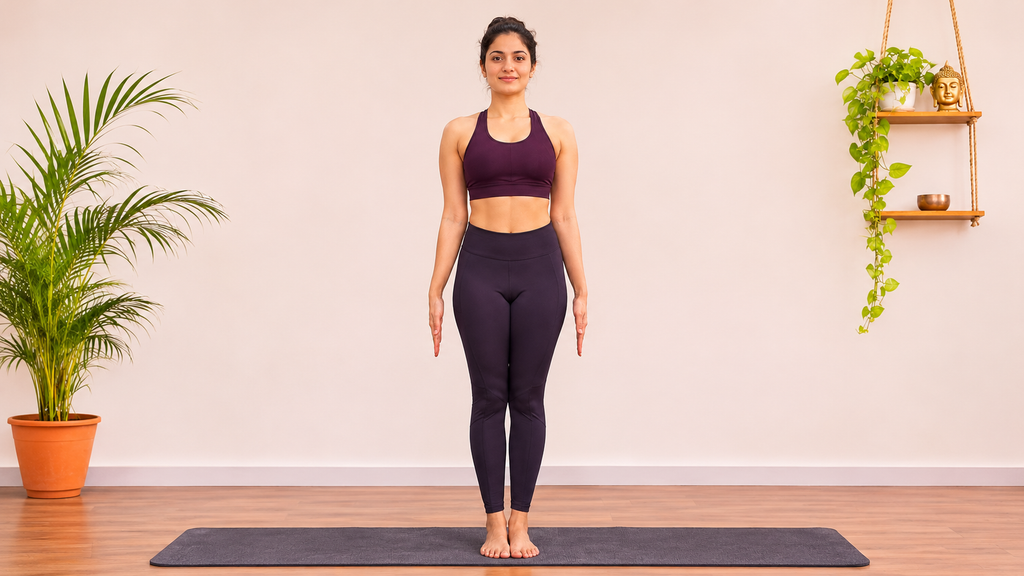
You may not think of standing still as a starting point for a practice, but Tadasana is a great place to begin. Stand with your weight evenly distributed and your arms relaxed. Keep your spine and neck long and relax your shoulders.
Take some slow, deep breaths.
Awareness of your posture can help correct any imbalances. For example, you may notice you’re putting more weight on one leg.
Why include it?
Mountain Pose helps with posture awareness and balance while helping strengthen and lengthen the muscles needed for other standing and standing movements.
A useful tip: Don’t push your chest out or stand unnaturally straight. Relax your posture.
2. Utkatasana (Chair Pose)
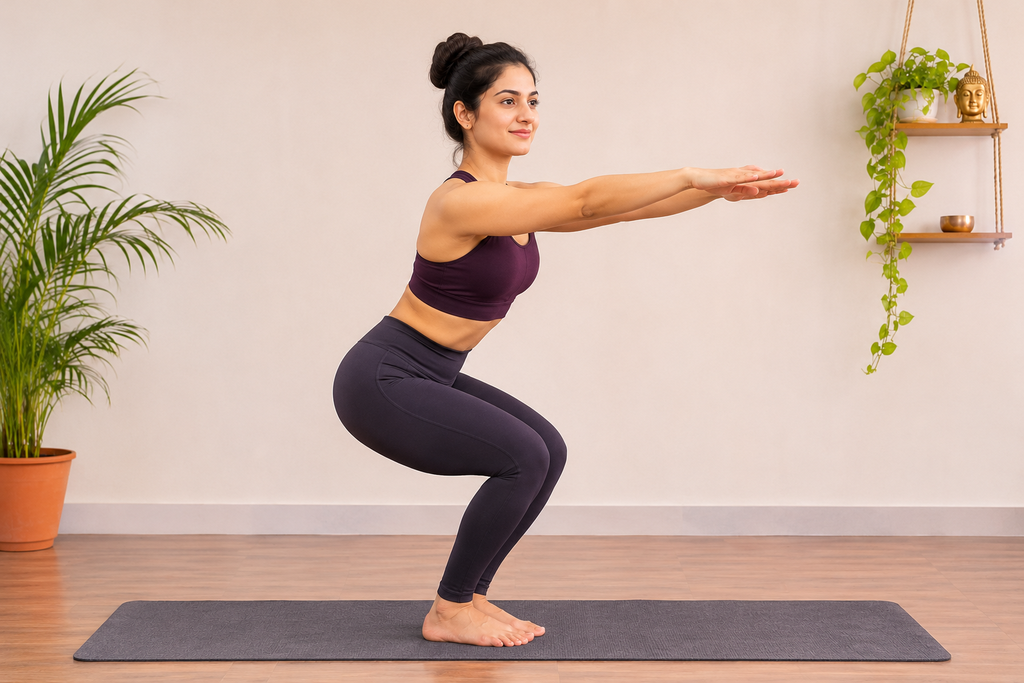
Chair Pose gives your legs and back a good stretch. This is one reason it makes a great addition to a power yoga practice.
Stand up and bend your knees to move your hips backwards as if you’re going to sit on a chair. Keep your weight evenly distributed through your feet. Extend your arms as you see fit (i.e. forward or overhead).
Hold for 3-5 breaths.
Chair Pose requires you to use your thighs, glutes, and core. It also works on your endurance.
People who are just starting will find it helpful to know that most people will try to squat as low as possible. It’s not necessary to engage your muscles that way. A more controlled, smaller bend is completely appropriate.
3. Adho Mukha Svanasana (Downward-Facing Dog)
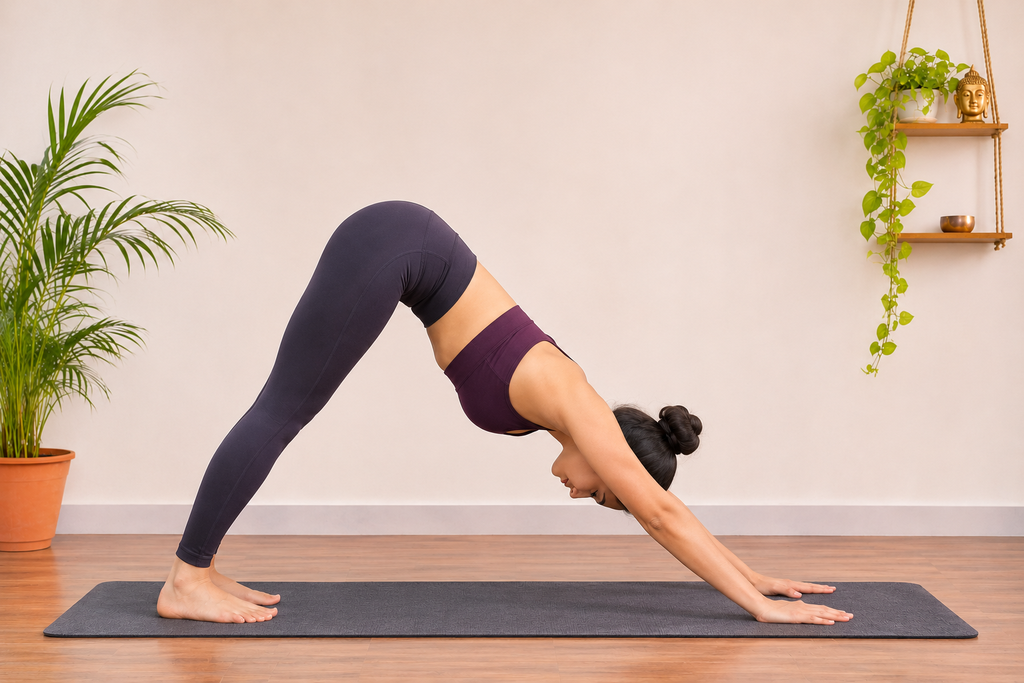
Start on your hands and knees.
Lift your hips up and backwards to make your body form an inverted V. If your hamstrings are tight, keep your knees slightly bent. The heels don’t have to touch the ground.
This pose works your arms and shoulders while improving mobility in your back legs.
Create as much length in your spine as possible rather than trying to fully straighten your knees. If your wrists bother you, use an alternative your teacher suggests.
4. Phalakasana (Plank Pose)
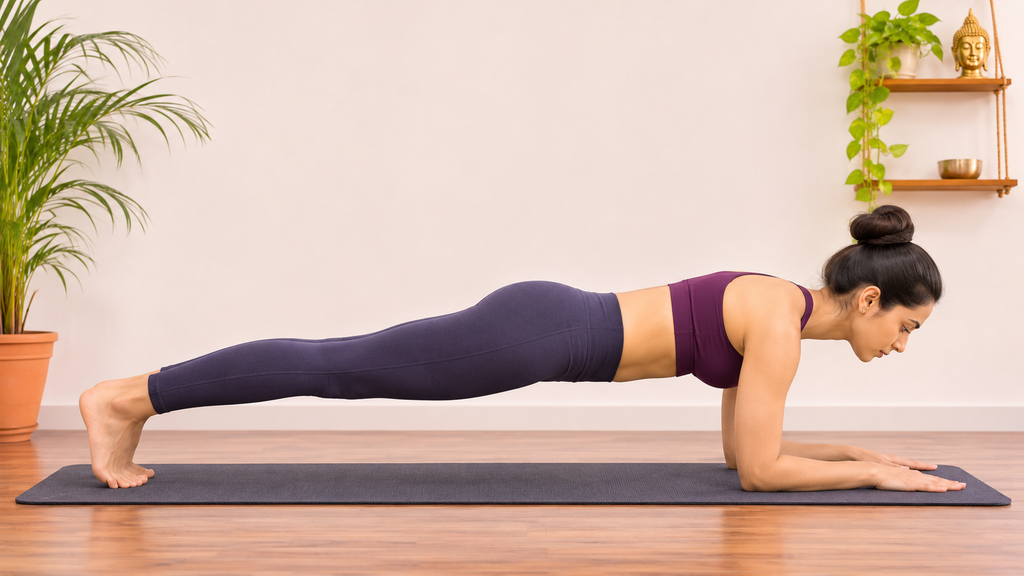
Plank is one of those yoga poses that is more difficult to properly perform than it seems. It works your core and arms.
Get into the position by extending your legs behind you with your hands directly underneath your shoulders.
Keep your body in a relatively straight line from your head to your heels.
Engage your abdominal muscles.
Avoid allowing your hips to sag.
Plank strengthens your core, shoulders, and arms and aids in body weight support.
If your lower back begins to arch or your shoulders feel unstable, lower your knees to the mat.
A knee-supported Plank is better than an unsupported full Plank.
5. Chaturanga Dandasana (Four-Limbed Staff Pose)
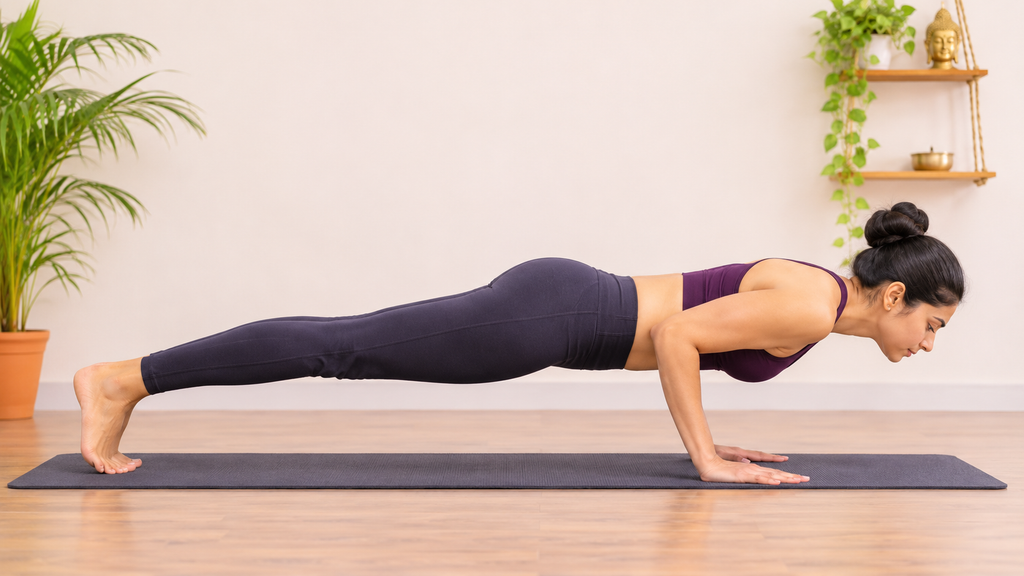
One of the more challenging poses in power yoga is Chaturanga.
It requires a good amount of control over the shoulders and strength in the upper body.
Start with your body in a straight line with your arms in a plank position.
Bend your elbows and lower your body while keeping your elbows close to your body.
It is better for beginners to lower their knees first for this move and practice a controlled lowering.
Chaturanga helps build strength in the arms, shoulders, and the core.
For this pose, don’t let your shoulders touch your arms and push your body down. This is better controlled with a different variation.
It is best to learn this with the help of an instructor.
6. Bhujangasana (Cobra Pose)
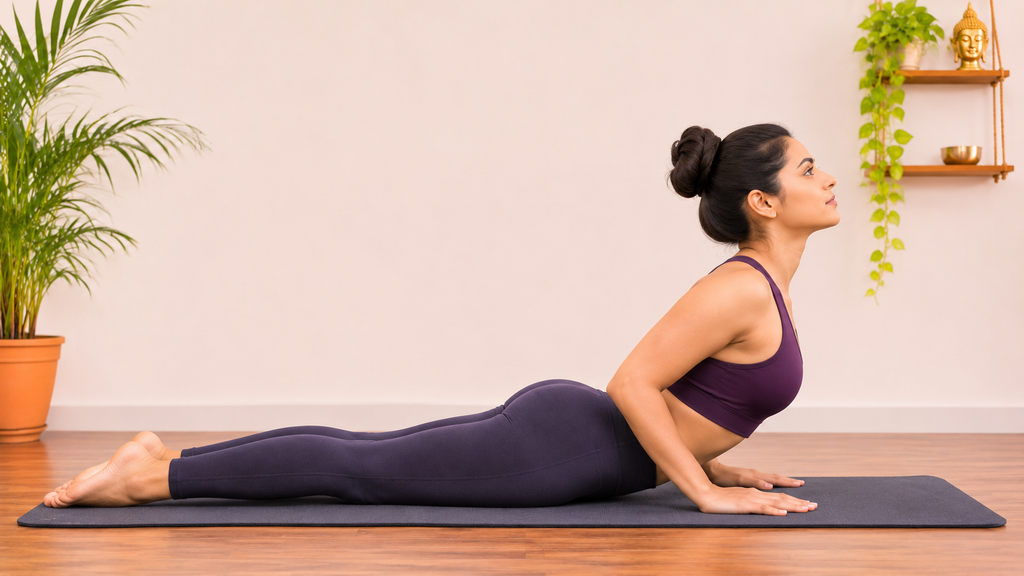
After a few strengthening moves, try Cobra Pose for a gentle spinal extension.
Lie on your stomach and put your hands next to your lower ribs.
Keep your elbows close to your torso and lift your chest while using your back to do most of the work and your hands to help a little.
Keep your hips on the mat.
This move engages your quads, back and core. Lift as high as you can without compressing your lower back.
Why include it?
Cobra Pose builds back strength and mobilizes the chest and spine.
A useful tip: Higher isn’t always better. A small lift with controlled breathing is more beneficial than forcing yourself into a deep backbend.
7. Virabhadrasana I (Warrior I)
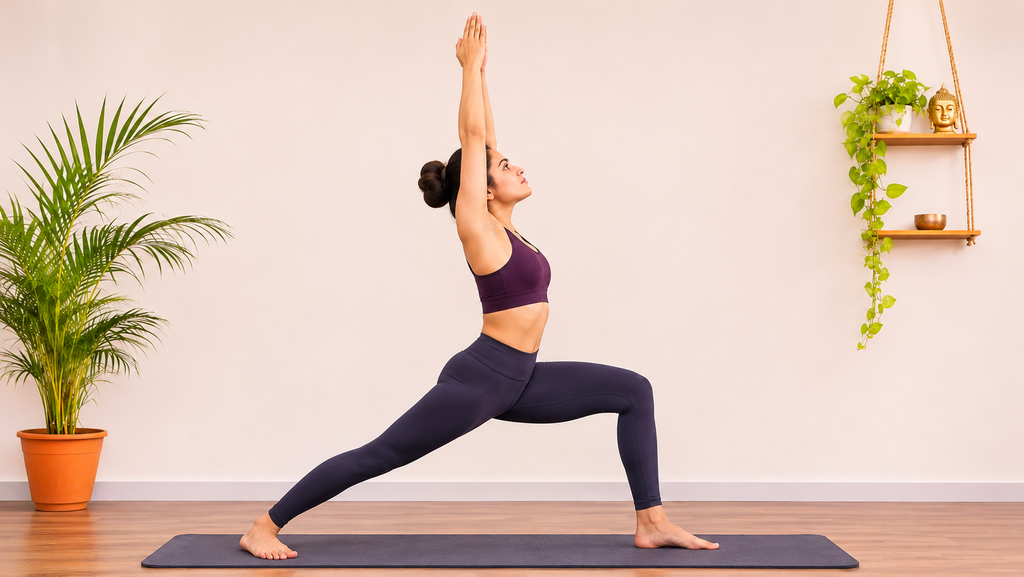
Warrior I is a strong standing posture that challenges both balance and endurance.
Step one foot forward and the other foot back.
Bend the front knee and keep the back leg active.
Lift your arms overhead if it’s comfortable or keep your hands on your hips.
Why include it?
Warrior I works your leg and core strength and balance while opening your hip flexors.
A useful tip: If bringing your hips completely forward creates discomfort, don’t force it A wider stance makes the posture more stable.
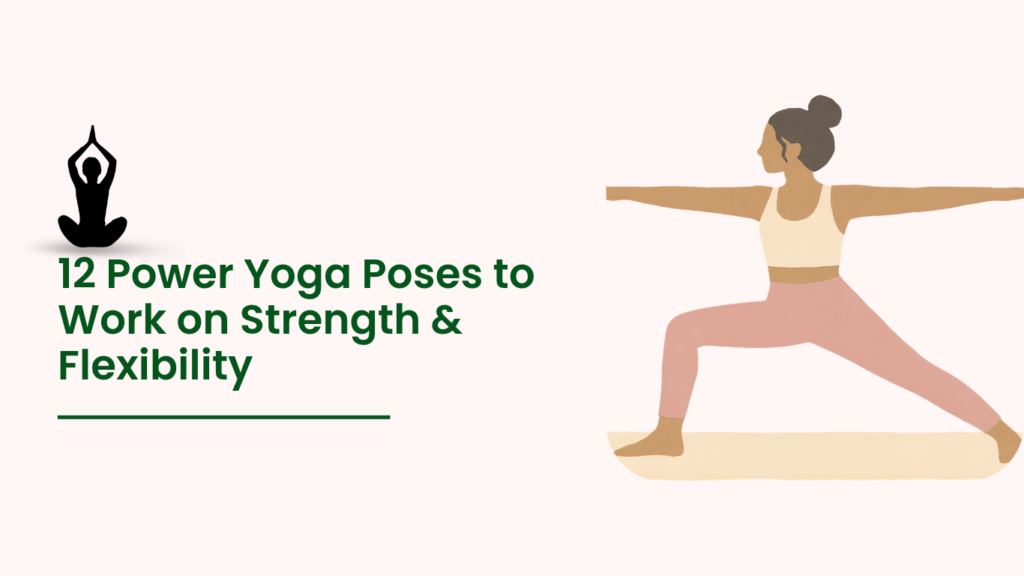
8. Virabhadrasana II (Warrior II)
This is a posture that works your legs without requiring complex movements.
Turn your front foot out.
Extend your arms in the opposite direction from your front leg.
Look toward your front hand while keeping your arms and shoulders relaxed.
Why include it?
This posture works your leg endurance and awareness while improving balance.
A useful tip: Watch your front knee. It should be in line with your toes. And remember to breathe. People often hold their breath when their legs begin to feel tired.
9. Trikonasana (Triangle Pose)
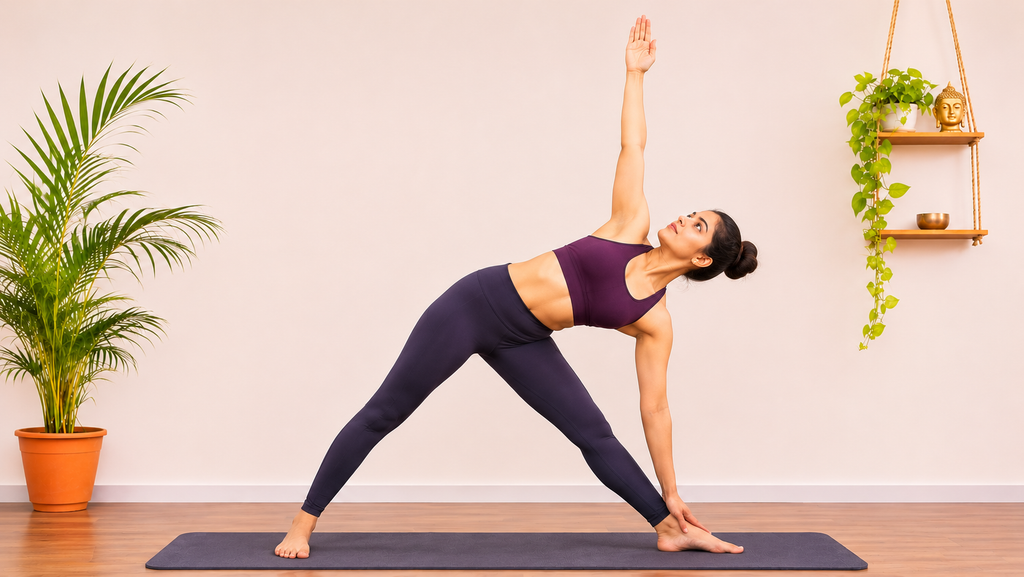
Trikonasana includes balance, strength, and mobility.
To begin, spread your feet wide apart.
Turn your front foot out and extend your arms out to the sides.
Reach your front hand forward and hinge at your hips to touch your shin or yoga block.
Extend your other arm up if it is within your range of motion.
Why include it?
Triangle Pose works the leg muscles and aids in mobility of the hips, spine and side of the body.
A useful tip: There is no prize for touching the floor. If you are unable to maintain the correct pose without touching the floor, use a block or touch your hand to your leg instead.
10. Setu Bandhasana (Bridge Pose)
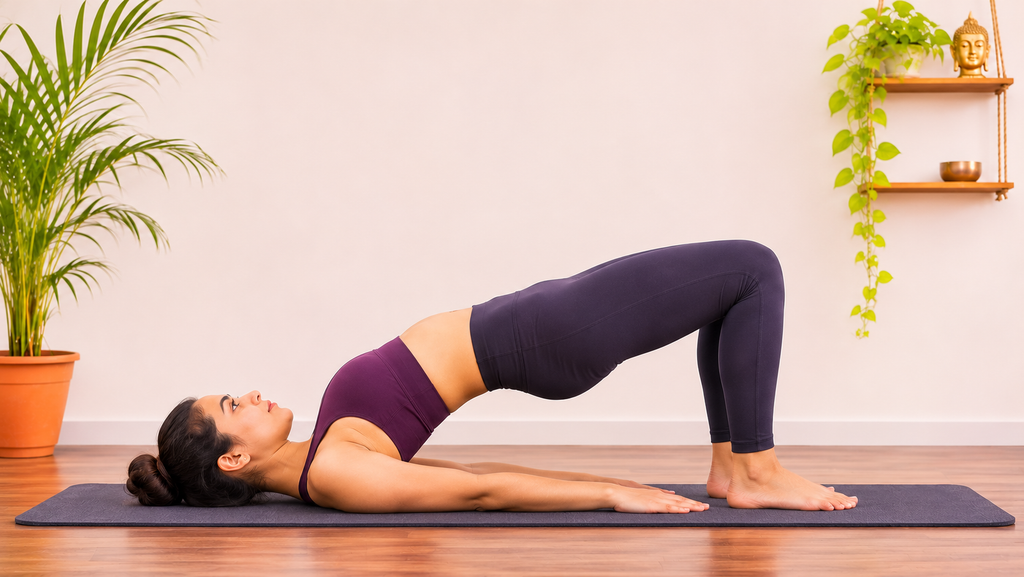
Bridge Pose is a good option for strengthening the glutes.
Begin lying on your back.
Bend your knees and place your feet flat on the floor.
Maintain a hip-width distance between your feet.
Lift your hips as high as you can without arching your back too much.
Hold the pose for a couple of breaths and then release by lowering your hips to the ground slowly.
Why include it?
Bridge Pose is a great hip and spinal strengthening posture.
A useful tip: Aim to keep your knees aligned instead of focusing on how high you can lift your hips.
11. Navasana (Boat Pose)
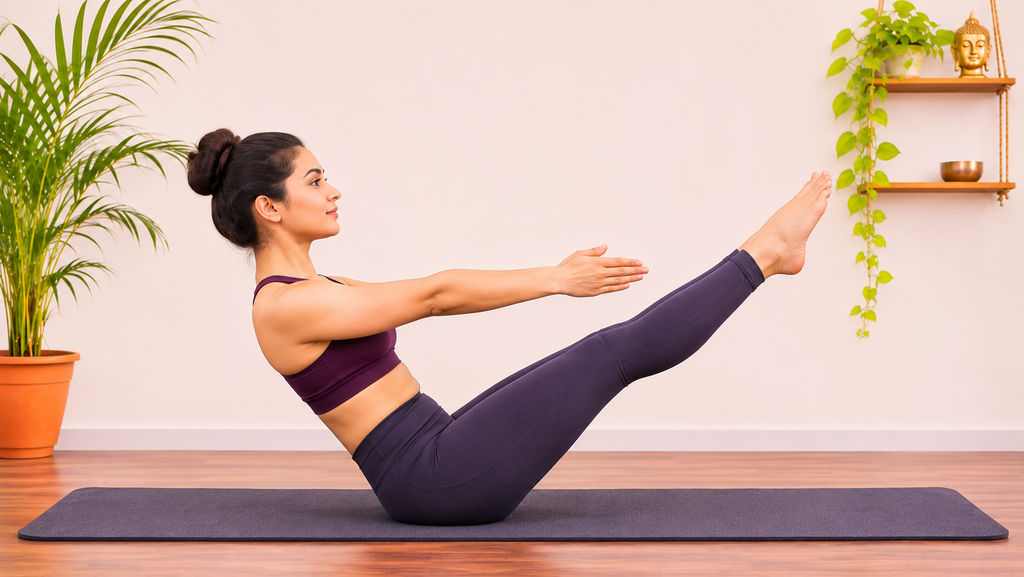
Boat Pose can be difficult for people who don’t practice yoga regularly.
Start by sitting on your mat with your knees bent and your feet flat on the floor.
Lean back so that your spine is flat and long.
Next, lift your feet, one at a time, if you can balance.
For support, you can hook behind your thighs.
Boat Pose is a great balance challenge and works your abdominal and hip flexor muscles.
Straightening your legs is optional. If your lower back is rounding too much, or you feel discomfort, keep your legs bent, or return to a more supported pose.
12. Vasisthasana (Side Plank Pose)
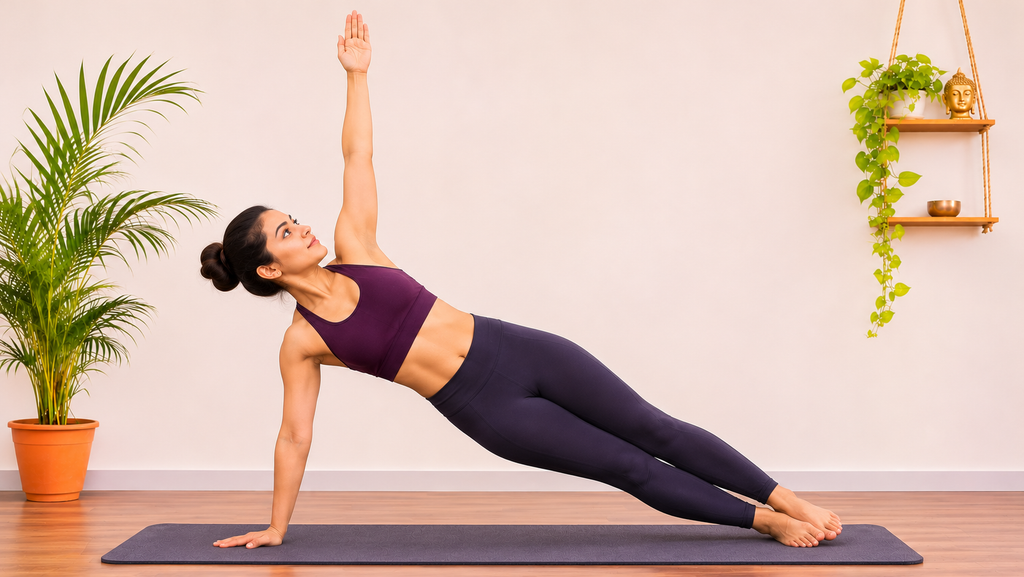
Side Plank strengthens your lateral stability and challenges your core and arms.
Start by being in a plank pose.
Rotate your body to one side while lifting your hand from the plank, and stacking the other on top of it.
Keep the bottom foot on the mat for support if you can’t rotate your body to the side completely, or if it’s just too challenging.
Once you feel stable, you can lift the bottom arm.
Side Plank is a great strengthening pose for your core and the lateral part of your arms.
A useful tip: the supported variation is totally fine to start with. This can be great if you don’t have enough shoulder strength to support your body weight in the full side plank.
What Are the Benefits of Power Yoga?
It builds functional strength. Poses like Plank and Warrior poses strengthen and stabilize various muscles of the body. Chair pose strengthens the legs and core.
It builds muscular endurance. Improved ability to endure physical effort is attained through repeated movement and effort.
It improves flexibility and mobility. Different poses improve the mobility of various parts of the body.
It develops balance and body coordination. Moving between various standing poses like Warrior I and II requires full-body coordination and control.
It is an active and moving exercise. Depending on the pace and effort, power yoga can help achieve a physical activity goal.
It may also aid in stress relief due to the movement and controlled breathing.
It helps improve overall well-being and quality of life, if done on a regular basis and at the right level of intensity.
Can Power Yoga Asanas Help With Weight Loss?
It is often the reason people take interest in power yoga.
Compared to other styles of yoga, it utilizes more continuous movement and body effort, which aids in physical activity and energy expenditure.
But can it help in losing body weight?
It can help achieve the goal, but not necessarily on its own.
Other contributing factors like metabolism, balance in body nutrition, rest and other physical activity, and an individual’s health condition all help in effective management of body weight.
Power yoga aids in the process when incorporated with healthy eating and other complementary exercises.
I’d recommend not treating every yoga session like a calorie-burning competition. Trying to move too fast to sweat more actually affects your technique and can cause injury.
Building strength, endurance, and overall wellness are better results and are sustainable. Those are results worth achieving regardless of what your scale says.
What Beginners Should Know Before Taking Up Power Yoga
Beginners sometimes think that the harder a yoga class is the better the results will be.
That’s not the case.
New to yoga? Learn the basics of alignment and breathwork before attempting a power yoga class.
A few things worth remembering:
Start with shorter sessions and work up to longer ones.
Use modifications without feeling bad about taking an “easier” or “shorter” version.
Listen to your body and stop if you experience sharp pain, dizziness, or discomfort.
Practise power yoga no more than 2-3 times per week. Use the other days to practise gentle yoga, go for a walk, or do another safe and easy activity.
Practise power yoga in a consistent and reasonable manner rather than exhausting yourself and not being able to practise for several days. A 25-minute enjoyable power yoga session is more helpful than a very demanding 60-minute class that you can’t repeat for several days.
Neither power yoga nor traditional yoga is inherently “better”.
If you are looking for a class with a focus on strength and stamina to flow from one move to the next, power yoga is for you.
If you are a beginner or have inflexibility and limited mobility, or just prefer a more easy-going pace, start with a Hatha class.
You are always free to experiment and combine different styles of classes throughout the week if you like.
Yoga has no rules.
The Most Important Thing is Learning To Move Well
When you start any new class, you get the opportunity to adapt. With power yoga, the focus can quickly turn to how long you can hold a move or how quickly you can get through the flows.
This can quickly become an unhealthy competition.
It’s not about how long you can hold a move compared to the person next to you.
Practice is about how well you move, and understanding your edges. Each day is different. Some days you’ll feel strong. Others you’ll feel weak.
Some days a particular move will feel hard.
It’s all normal.
Perfect flexibility is not required to start. Nor is expensive gear.
All that’s required is the space and will to practise consistently.
Don’t you know where to start? A class with an instructor can get you moving in the right direction.
Start Your Power Yoga Journey with Yogiva
At Yogiva, our power yoga classes focus on you and your body rather than forcing you to keep up with a pace that is unsuitable and ultimately undermines the spirit of yoga.
We teach the foundational elements and offer the chance to practise with modification rather than forcing you to keep up with an instructor who is out of your league.
Practice with us at home, on your schedule.
Take advantage of Yogiva’s virtual classes and see what aligns with your schedule.**
Frequently Asked Questions
1. What are some basic power yoga asanas for beginners?
The asanas Tadasana, Chair Pose, Downward-Facing Dog, modified Plank, Warrior I and Warrior II are good starting poses. For beginners, it is more important to work on proper form and movement quality than to attempt more advanced poses.
2. Can power yoga help increase flexibility?
Yes, it can. One of the benefits of practicing power yoga is improving flexibility and mobility, especially when movements are performed under control and within a comfortable range.
3. Is power yoga a good aid for weight loss?
Power yoga helps increase energy expenditure and physical activity, but weight loss depends on the overall lifestyle and health of an individual.
4. Can I do power yoga every day?
Frequent practice is normal for some experienced practitioners, but beginners need to ensure adequate recovery between demanding practices. Alternating between a demanding practice, like power yoga, and a less demanding practice, like gentle or restorative yoga, is an example of an appropriate plan.
5. Is power yoga suitable for someone who isn’t flexible?
Yoga is appropriate for all levels of flexibility and mobility. Don’t let a lack of flexibility deter you from beginning a practice. Utilize beginners-only practices and modifications and gradually work toward improved mobility.
6. How long should a power yoga session last?
15 to 25 minutes is an adequate starting length for beginners. Longer sessions can be implemented as you become more conditioned for practice.
7. What is the difference between power yoga and Vinyasa yoga?
Vinyasa yoga has a flowing sequence that is linked with breathing, and like power yoga, varies from teacher to teacher in terms of intensity.